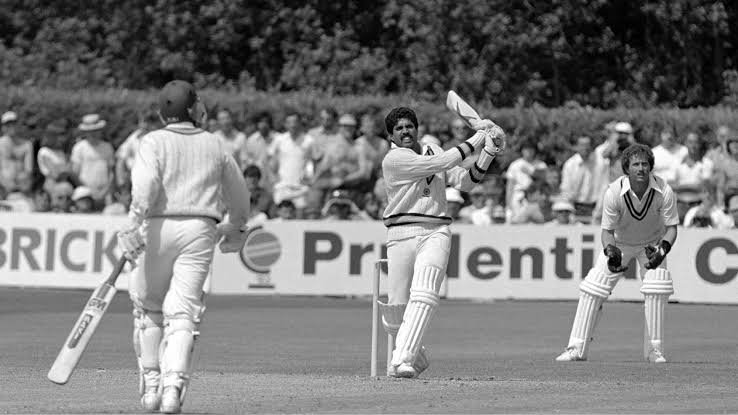



Tunbridge Wells, June 18, 1983.
India were in serious trouble.
The scoreboard read 17 for 5 against Zimbabwe in the 1983 World Cup.
The situation was almost unthinkable for a team that still had hopes of reaching the semi-finals. India had already suffered defeats against Australia and the West Indies, and another loss could have ended their campaign.
Then came India’s captain.
Kapil Dev walked out to bat.
What followed was not just an extraordinary innings. It became one of the most famous chapters in Indian cricket history.
Kapil scored an unbeaten 175 from 138 balls, hitting 16 fours and six sixes, rescuing India from 17/5 and taking them to 266/8. India eventually defeated Zimbabwe by 31 runs.
But there is an extraordinary twist to this story.
There is no television footage of Kapil Dev’s 175.
India Were 17/5
India entered the match knowing that the game was crucial.
They had started the 1983 World Cup with an unexpected victory over the mighty West Indies and had also defeated Zimbabwe in their opening meeting.
But losses against Australia and the West Indies had suddenly put their campaign under pressure.
Against Zimbabwe at Tunbridge Wells, things went from bad to worse.
India were reduced to 9/4, and soon the scoreboard showed 17/5.
The team that had dreamed of reaching the semi-finals appeared to be heading towards another defeat.
Kapil Dev, however, had different plans.
Then Kapil Dev Took Over
The Indian captain began rebuilding the innings.
Instead of simply trying to survive, Kapil attacked.
Boundary after boundary changed the momentum of the match.
He found gaps, cleared the ropes and gradually transformed India’s position from one of complete crisis to one of control.
By the time he reached his century, India had moved from survival mode into a position from which they could actually challenge Zimbabwe.
Kapil eventually finished unbeaten on 175, having faced only 138 deliveries.
At the time, it was the highest individual score in ODI cricket. It was also the highest score in World Cup cricket.
The Partnership That Saved India
Kapil did not do it entirely alone.
After India slipped further to 17/5, Syed Kirmani joined him at the crease.
The pair produced a remarkable recovery.
Kapil and Kirmani put together a 126-run partnership for the ninth wicket, which was then a world record for the format.
From 17/5, India eventually reached 266/8.
The difference was extraordinary.
A total that had looked impossible when Kapil arrived at the crease suddenly gave India a chance to win.
And they did.
Zimbabwe’s chase eventually ended at 235, giving India a 31-run victory.
The result kept India’s World Cup campaign alive.
A Record-Breaking Knock Nobody Could Watch on Television
This is perhaps the most remarkable part of the entire story.
In today’s cricket world, an innings like Kapil’s would be replayed thousands of times.
Every six would become a social-media clip.
Every boundary would be available on YouTube.
Every fan could watch the innings whenever they wanted.
But in 1983, that was not the case.
The match was not televised because of a BBC technicians’ strike.
As a result, the vast majority of cricket fans never saw Kapil’s 175 live.
Only the spectators present at the Nevill Ground in Tunbridge Wells witnessed the innings as it happened.
That makes Kapil’s innings one of cricket’s most famous pieces of unseen history.
There are stories, newspaper reports, photographs and memories.
But no complete television footage exists.
From 17/5 to the World Cup Final
Kapil’s innings did more than rescue one match.
It gave India’s World Cup campaign a second life.
India went on to defeat Australia in another crucial group match and qualify for the semi-finals.
In the semi-final, India defeated hosts England to reach the World Cup final.
Waiting for them at Lord’s were the West Indies, the two-time defending champions.
India were massive underdogs.
The West Indies had won the first two editions of the World Cup and possessed one of the most feared bowling attacks in world cricket.
India, meanwhile, had entered the tournament having won only one match across the first two World Cups.
But the Indian team had already learned something in Tunbridge Wells.
They could survive against the odds.
The Final at Lord’s
On June 25, 1983, India were bowled out for just 183.
Against a West Indies side featuring greats such as Viv Richards, Malcolm Marshall, Andy Roberts and Joel Garner, the total appeared modest.
But India’s bowlers refused to surrender.
The West Indies were eventually dismissed for 140.
India had won the World Cup by 43 runs.
Kapil Dev became the first Indian captain to lift the Cricket World Cup.
And suddenly, the innings at Tunbridge Wells looked even more significant.
The Catch That Followed the 175
Kapil’s contribution in the final wasn’t limited to leadership.
With West Indies chasing 184, Viv Richards began attacking India’s bowlers.
He looked capable of changing the final.
Then came one of the defining moments of the match.
Richards mistimed a pull shot off Madan Lal.
Kapil Dev ran backwards and completed a stunning catch.
The wicket changed the momentum of the final, and India eventually completed one of the greatest upsets in World Cup history.
Why Kapil’s 175 Still Matters
The number 175 is now part of Indian cricket folklore.
But the importance of that innings goes beyond the statistics.
It represented a moment when an Indian team that had been written off refused to accept the situation it found itself in.
From 17/5 to 266/8.
From the possibility of an early World Cup exit to the semi-finals.
And ultimately, from being outsiders to becoming World Champions.
The innings also became part of the story of how Indian cricket grew after 1983. The sight of Kapil Dev lifting the World Cup at Lord’s inspired a generation of young Indians, including future stars such as Rahul Dravid and Sachin Tendulkar, according to the ICC’s retrospective on the tournament.
The Innings We Remember Without Ever Seeing
There are thousands of famous cricket innings preserved forever on video.
Kapil Dev’s 175 is different.
It is remembered through statistics, photographs, newspaper accounts and the people who were fortunate enough to watch it at the ground.
No complete television recording exists.
Yet decades later, cricket fans still talk about it.
Perhaps that is what makes the story so powerful.
Kapil Dev’s 175 was an innings that India almost lost — and then an innings that India never forgot.
Kapil Dev’s 175* — The Numbers
Opponent: Zimbabwe
Tournament: 1983 Cricket World Cup
Venue: Nevill Ground, Tunbridge Wells
Score: 175*
Balls: 138
Fours: 16
Sixes: 6
India’s final score: 266/8
India’s result: Won by 31 runs
Starting position: India 17/5
Partnership with Syed Kirmani: 126 runs
Historic fact: No television footage of the innings exists.


Leave a Reply