








For Roshibina Devi, the Asian Games have never been just another tournament.
They have become a timeline of her career — bronze, silver and now another silver — with each edition adding another chapter to the story of a young girl from Manipur who steadily built herself into one of India’s most consistent Wushu athletes.
On Thursday, September 24, 2026, Roshibina Devi added another medal to that remarkable journey.
The 25-year-old Indian won the silver medal in the women’s 60kg Sanda event at the Asian Games 2026 in Aichi-Nagoya, losing 0-2 to China’s Zhang Xiaoyu in the gold-medal bout.
The result may not have been the gold she wanted, but the silver carries a much bigger significance.
Roshibina has now won a medal at three consecutive Asian Games — bronze in 2018, silver in 2023 and silver again in 2026.
She has become the first Indian Wushu athlete to win medals at three successive Asian Games.
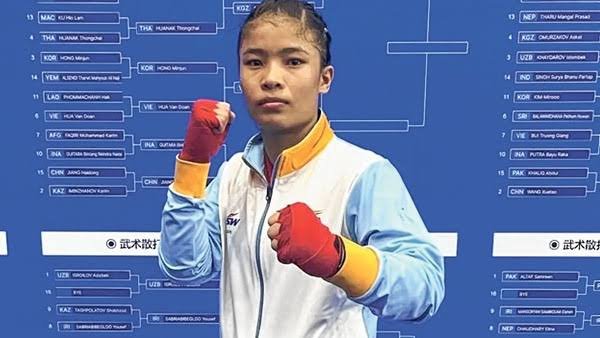
From a Small Village in Manipur to the Asian Podium
Roshibina Devi was born in Kwasiphai Mayai Leikai in Manipur’s Bishnupur district.
Her sporting journey began when she was still a young athlete. In 2012, she joined a Sports Authority of India centre and began training in Wushu. Before settling into Wushu, she had also tried boxing, but watching Wushu at a district-level competition sparked a different interest.
She eventually found her place in Sanda — the combat discipline of Wushu that combines striking and throwing techniques.
The early years were not built around fame or big stadiums. They were about training, travelling, learning and making sacrifices.
Roshibina comes from a farming family, and her father, Naorem Damu Singh, supported her sporting ambitions during the difficult early stages of her career. Reports have noted that her family even sold a piece of land to help fund her training and travel.
That background makes the medals she has collected at the Asian Games even more meaningful.
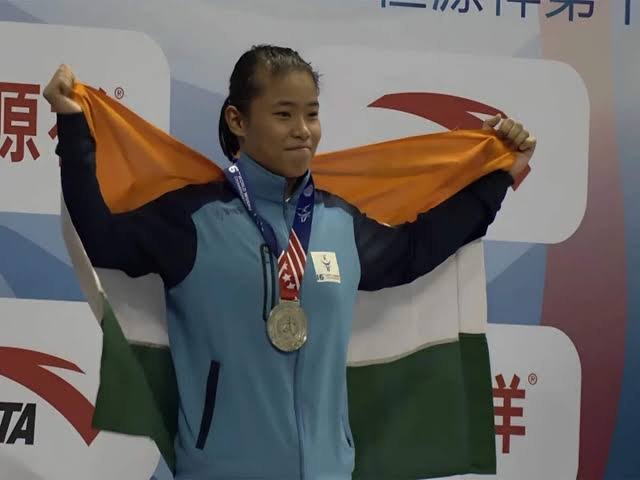
The First Asian Games Medal Came at Just 17
Roshibina made her Asian Games debut at the 2018 Jakarta-Palembang Games.
She was only 17.
Competing in the women’s 60kg Sanda category, she defeated Pakistan’s Mubashra Akhtar in the quarterfinals to guarantee herself a medal.
Her campaign ended in the semifinals against China’s Cai Yingying, but the teenager returned home with a bronze medal.
It was the beginning of something that few could have predicted at the time.
Roshibina had made the Asian Games podium.
She would not leave it in her next two appearances.
From Bronze to Silver at Hangzhou
Five years later, Roshibina returned to the Asian Games at Hangzhou.
This time, expectations were different.
She was no longer an inexperienced teenager making her continental debut. She was an established Indian Wushu athlete looking to improve on her first Asian Games medal.
And she did.
At the 2023 Hangzhou Asian Games, Roshibina reached the women’s 60kg Sanda final and won the silver medal after losing to China’s Wu Xiaowei.
Her medal was particularly significant for Indian Wushu and represented another step forward in her Asian Games career.
Bronze had become silver.
Then Came the Roadblock Before Asian Games 2026
The journey to her third Asian Games medal was far from straightforward.
Roshibina initially missed out on India’s original 2026 Asian Games squad after losing the selection trial in June.
Divyanshi Choudhary won the trial and was initially selected for the women’s 60kg Sanda category.
Roshibina appeared set to miss the Asian Games for the first time since making her debut in 2018.
Then circumstances changed.
According to the Wushu Association of India, Divyanshi was later ruled out after an MRI showed a high-grade ACL injury. Roshibina was subsequently brought into the Indian squad as her replacement.
Her return came only around September 10, leaving her with limited time to prepare for the Games.
For an athlete who had already spent months outside the national camp, the challenge was enormous.
But Roshibina had another opportunity.
And she took it.
Three Fights. Another Asian Games Final.
Once the competition began, Roshibina looked like an athlete who knew exactly what was at stake.
She defeated Bangladesh’s Shika Khatun in the pre-quarterfinals.
Then came the quarterfinal against Macau’s Chu Man Sin.
Roshibina won that bout 5-0, guaranteeing herself at least a bronze medal and, with it, a place in Asian Games history.
She followed that with a 2-0 semifinal victory over Indonesia’s Thania Kusumaningtyas, booking another place in the Asian Games final.
The colour of her medal was still undecided.
But the historic third medal was already within reach.
The Final: Silver Again
The gold-medal bout brought Roshibina face-to-face with China’s Zhang Xiaoyu.
It was a difficult final for the Indian fighter.
Zhang controlled the contest with aggressive attacks and effective side-kicks. Roshibina tried to defend and create opportunities with her own throws, but the Chinese fighter maintained the advantage.
Zhang eventually won the final 2-0, with all five judges scoring both rounds in her favour.
Roshibina had to settle for silver.
Again.
There was disappointment because she had come looking for gold.
But behind that disappointment was a historic achievement.
2018 Bronze. 2023 Silver. 2026 Silver.
Roshibina’s Asian Games record now tells its own story:
2018 Jakarta-Palembang — Bronze
2023 Hangzhou — Silver
2026 Aichi-Nagoya — Silver
Three appearances.
Three medals.
And three consecutive Asian Games podium finishes.
Her latest silver also gives her two consecutive Asian Games silver medals in the women’s 60kg Sanda category.
That consistency is what separates this achievement from an ordinary medal-winning performance.
Roshibina has returned to the Asian podium every time she has competed at the Games.
More Than Just an Asian Games Medal
Roshibina’s success is not limited to the Asian Games.
She won gold in the women’s 60kg Sanda event at the 2019 South Asian Games. In 2023, she also won silver at the World Wushu Championships in Texas and gold at the Moscow Wushu Stars Championship.
Those achievements contributed to her receiving the Arjuna Award in 2023.
The award was another recognition of a career that had already moved well beyond a single tournament.
Yet the Asian Games remain special.
Perhaps because they have followed her career from teenager to established international athlete.
A Medal That Came After a Second Chance
There is another layer to Roshibina’s 2026 medal.
She wasn’t originally supposed to be in the Indian squad.
She had lost the selection trial.
She had spent time away from the national camp.
And when she finally received the call, she had only limited preparation time.
Still, she walked into the competition and reached another Asian Games final.
That makes the 2026 silver less about the colour of the medal and more about the road she travelled to get there.
Roshibina herself acknowledged after the final that she had wanted to win gold and felt disappointed that she could not give India the top medal. But she also said she wanted her journey to inspire other athletes.
That may ultimately be the most lasting part of her Asian Games story.
The Story Continues
At 25, Roshibina Devi already has three Asian Games medals, an Arjuna Award and a collection of international results that has established her as one of India’s leading Wushu athletes.
But her journey is not finished.
The bronze from Jakarta showed what she could do.
The silver at Hangzhou showed that she could come closer to the top.
The silver at Aichi-Nagoya showed something different — that even after losing her original place in the squad and returning with limited preparation, she could still find her way back to the Asian Games podium.
Bronze. Silver. Silver.
For Roshibina Devi, those three medals are more than numbers on India’s medal table.
They are the story of a young athlete from Manipur who kept coming back — and every time she did, she came back with a medal.